Water can look perfectly clean and still contain plenty of dissolved material. That’s one of the strange things about water quality. A glass can be crystal clear, have no obvious smell, and yet contain minerals, salts, and electrically charged particles that you simply can’t see.
For everyday drinking and household chores, removing every dissolved substance usually isn’t necessary. But certain applications need water that is much cleaner than ordinary filtered or treated water. That’s where deionization enters the picture.
What Is Deionized Water?
Deionized water is water that has had many dissolved ions removed. These ions can include positively charged particles such as calcium, magnesium, and sodium, along with negatively charged ions such as chloride, sulfate, and bicarbonate.
The process generally uses ion-exchange resins. These resins attract and exchange unwanted ions, producing water with a very low ionic content.
It sounds highly technical, but the concept is fairly simple: instead of physically trapping particles with a normal filter, ion exchange targets dissolved charged substances that are too small to be handled by conventional filtration.
How Deionization Systems Work
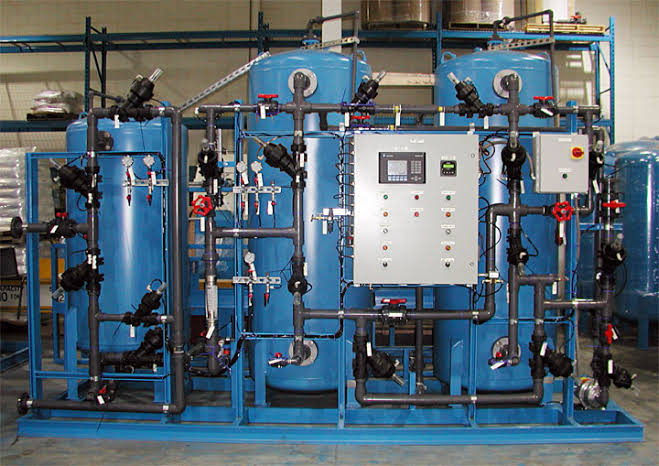
Modern deionization systems typically use one or more resin beds. Cation-exchange resins remove positively charged ions, while anion-exchange resins target negatively charged ions.
Some systems combine both types of resin in a mixed bed. When properly designed and maintained, mixed-bed deionization can produce water with extremely low ionic conductivity.
Also read: Why Testing Your Water First Leads to Better Treatment DecisionsHowever, deionization isn’t designed to remove everything. It mainly targets ions. Depending on the water source and system configuration, other technologies may be needed to address microorganisms, suspended particles, organic compounds, or other contaminants.
That’s an important distinction, especially when people assume “deionized” automatically means “completely pure.”
Why Would Anyone Need Ultra-Pure Water?
For some jobs, ordinary tap or filtered water simply isn’t clean enough.
Laboratories, electronics manufacturing, pharmaceutical processes, scientific instruments, and certain industrial applications may require ultra-pure water because even tiny concentrations of contaminants can interfere with sensitive processes.
Think about electronics manufacturing. A trace amount of unwanted material can potentially affect a delicate production process. In a laboratory, dissolved ions may interfere with testing or chemical reactions. In these settings, water quality isn’t just about whether the water is safe to drink. It’s about whether the water behaves predictably.
That’s a very different requirement from filling a glass at home.
Also read: Finding a More Convenient and Reliable Way to Enjoy Better WaterDeionization Versus Reverse Osmosis
Deionization and reverse osmosis are often mentioned together, but they work differently.
Reverse osmosis uses pressure and a semipermeable membrane to reduce many dissolved substances and contaminants. Deionization, by contrast, uses ion-exchange materials to remove charged ions.
In many sophisticated water-treatment setups, the technologies are used together rather than treated as competitors. Reverse osmosis can reduce much of the dissolved load before water reaches the deionization stage. This can help the resin last longer and make the overall system more efficient.
The exact setup depends on the source water and the required quality. There’s no universal recipe.
Is Deionized Water Suitable for Drinking?
This question comes up often, and the answer isn’t simply “yes” or “no.”
Deionization is primarily a treatment process for removing ions, not a complete drinking-water purification strategy. A deionizer may not be designed to address every type of contaminant that could matter for drinking-water safety.
For household drinking water, systems should be selected according to applicable drinking-water standards and the actual contaminants present. If you’re considering a treatment system for consumption, it’s sensible to focus on equipment specifically designed and certified for that purpose.
Also read: Why Good Electrical Work Starts Long Before the First Wire Is ConnectedIn other words, don’t choose a system just because its specifications sound impressive.
Does Every Home Need Deionized Water?
Not at all.
Most households don’t need extremely low-ion water for everyday activities such as cooking, bathing, washing clothes, or making coffee. In fact, removing minerals that aren’t causing a problem can add complexity and expense without offering a meaningful benefit.
There are exceptions, of course. Certain hobbies, equipment, cleaning processes, and technical activities can benefit from lower-mineral water. But those needs are generally quite different from ordinary household water treatment.
For most people, understanding the water quality problem first is a better strategy than chasing the highest possible level of purity.
When Specialized Home Use Makes Sense
There are situations where specialized home use can justify a deionization setup. For example, some enthusiasts use highly purified water for particular equipment, detailed cleaning tasks, or applications where mineral deposits are especially troublesome.
Also read: Protecting Plumbing and Equipment from Scale, Corrosion, and Water DamageHowever, even in these cases, the system should match the intended purpose. A small point-of-use deionizer may be perfectly adequate for an occasional task, while a larger setup could be unnecessary.
It’s also worth considering how quickly resin capacity will be consumed. Water with a high ionic load can exhaust deionization resin much faster than relatively low-TDS water.
Maintenance Is Not Optional
Like any water-treatment technology, deionization requires attention.
Resin eventually becomes exhausted and loses its ability to exchange ions effectively. Some systems use conductivity or resistivity meters to monitor output quality. When performance starts moving outside the desired range, the resin may need regeneration or replacement.
Poor maintenance defeats the whole purpose of installing the system. A neglected unit can provide water quality that is nowhere near what the owner expects.
Choosing the Right Water Treatment
The best water-treatment system isn’t necessarily the most advanced one. It’s the one that solves the actual problem.
Also read: When Your Heat Pump Needs Attention, Experience Makes a DifferenceStart by testing your source water. Understand its mineral content and identify any specific contaminants that matter. Then determine what quality level your application actually requires.
For everyday drinking, conventional treatment technologies may be enough. For technical applications, a combination of filtration, reverse osmosis, deionization, UV treatment, or other technologies may be appropriate depending on the circumstances.
Water treatment is a little like buying tools: you wouldn’t use a precision laboratory instrument to tighten a loose kitchen cabinet.
A Practical Way Forward
Deionization is a powerful technology, but its value comes from using it for the right reason. It can dramatically reduce dissolved ions and play an important role in applications where consistent, low-ion water matters.
For homeowners, the smartest move is usually to avoid chasing “pure” water simply because it sounds better. Find out what’s actually in your water, identify what you need to remove, and choose a system around that information.
Clean water is useful. Precisely treated water can be even more useful — but only when there’s a real purpose behind it.